
The #1 Most Important Muscle to Fix Neck Hump
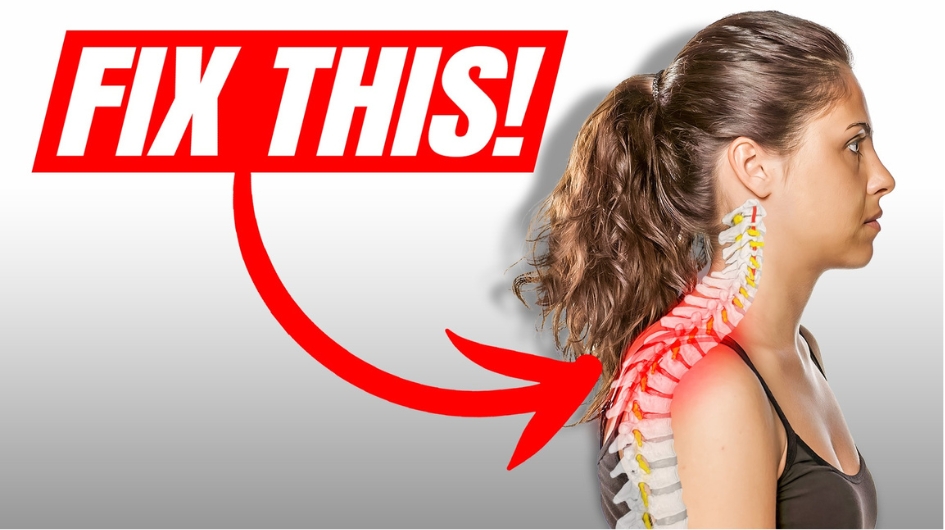
Here is a summary of what was covered in the video. I hope you find it helpful.
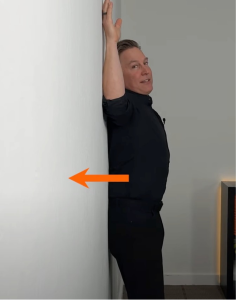
Performing the Wall Angel Test
How to Perform the Test
- Stand with heels about 6” from the wall
- With your buttocks and shoulder blades against the wall, try and get your elbows, wrists, and head all against the wall at the same time.
- Ideally you can also flatten your back to the wall while keeping all the other body parts also touching the wall.
What to Look For
- Are you unable to get your elbows and/or wrists against the wall? This many times is due to tight pectoralis muscles
- Are you overarching your lower back? That can signal upper back stiffness and rounding.
- Is your head unable to touch the wall? – This can point towards an upper crossed type postural syndrome. Check out this video for more information on that.
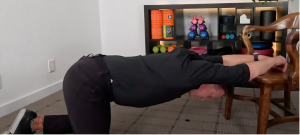
Exercise #1 – Upper Back Cat Stretch
Preparation: You will need a sturdy chair or couch.
Exercise Direction: Kneel in front of a chair. Place forearms on the edge of the seat. Walk knees back so that your thighs are vertical, knees under hips. Slightly round upper back, then drop chest downwards, feeling a stretch across pecs and shoulders.
Key Points: Go slow and easy. If you haven’t used or stretched your shoulders above your head in awhile it is going to take some time to regain flexibility. Stay in your comfort zone. Don’t push into pain.
Sample Program: Hold for 10 seconds, then come back up and repeat for 6 reps.
Variation: An adapted version of this stretch can be done as the yoga pose called “Child’s Pose” an performed on a bed or floor.
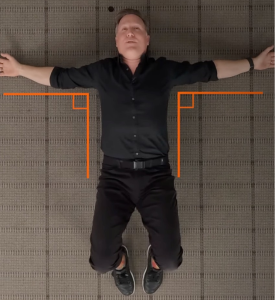
Exercise #2 – Passive Pectoralis Stretch on a Foam Roller
Preparation: You will need a 36” foam roller. I use this foam roller. And this exercise, when using a foam roller, requires some good balance, so practice it on a soft surface, go slow, and get help from someone else for your first few times.
Exercise Direction: Begin by sitting on the foam roller and carefully roll backwards onto your spine until you head is supported. Keep your feet wide apart for more stability (narrower feet add more of a core and balance challenge). Let your arms fall to the sides, palms facing up at 90 degree angle initially. To stretch the pec sternal division bring arms up to about 130 degrees. Relax and let gravity gently stretch your chest muscles for 1 minute (less if you are new to the stretch).
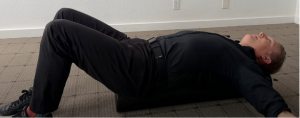
Key Points: You can use a towel or pillow under your head if needed.
Sample Program: 3 sets of 1 minute holds.
Variation: As alternate variations you can do this exercise on the floor without the foam roller or by letting one of your arms at a time hang off the side of a bed or couch.
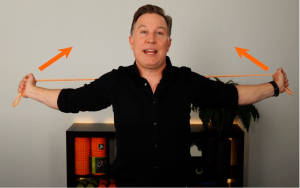
Exercise #3 – Banded Pectoralis Stretch
Warning: If you have a history of shoulder instability or shoulder dislocation this exercise is not advised.
Exercise Direction: Grasp a light resistance band in your hands, palms down, with your hands about 3 feet apart and no stretch on the band. Slowly bring your arms up overhead and, if possible, behind your head in a full arc. Stop at a comfortable point and never push into or through any pain. Hold the stretch for 10-15 seconds and try to work up to 1 minute holds.
Key Points: After you have become comfortable with your range of motion you can adjust the pre-stretch on the resistance band to get more of a stretch.
Sample Program: 3 sets of 1 minute holds.
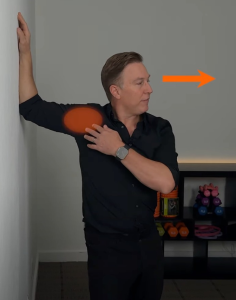
Variation: Doorway / Wall Variation – place forearm against a doorway or wall with elbow at shoulder level. Gently step forward with foot nearest the wall and slowly rotate your body away to feel a stretch at the pec muscle (clavicular division). Moving the elbow higher than the shoulder targets more of the sternal division. Hold for 10-15 seconds and see if you can build up to a 1 minute hold for this stretch.
These are the resistance bands I use
These other videos might also help you. Check them out now.
Do not use this content to avoid going to a licensed healthcare professional or to replace the advice they give you. Consult with a doctor before beginning any new exercise regime. Exercise may not be appropriate in some cases. None of these exercises should cause any pain or discomfort – stop doing the exercise immediately if it causes any discomfort.