
We shouldn’t let Hollywood teach us anatomy, because when we think of “the core” of the human body, we imagine chiseled 6-pack abs. One of the biggest mistakes in fitness is assuming a stronger core means stronger abs. In reality, some people with visible six-pack abs still have poor spinal stability and recurring back pain.
The next biggest mistake is thinking the core is 2 dimensional…just what we see from the front. That’s like saying a soda can is only the label on the front. In reality, it’s a multilayer, 360-degree cylinder around the spine. The front is the abs, the sides are the obliques, the back is the spinal extensors, and the system is capped above by the diaphragm and below by the pelvic floor.
All of these work together as a pressure system that supports and controls the spine during movement. That pressure system is the key. When it functions well, it creates internal support for the spine by increasing intra-abdominal pressure. When one of the sides of your core is weak, it’s like poking a hole in the soda can. You lose pressure in the whole system, and put that weak area at risk for further damage.
Most people don’t think about their core until something goes wrong. It usually shows up in ordinary moments, like picking up a child, putting socks on, loading the dishwasher, or moving a piece of furniture just a few inches. The low back tightens, or feels “off,” and suddenly the core becomes relevant.
Core Endurance vs Core Strength
The majority of everyday injuries don’t come from one heavy lift. They come from repeated, poorly controlled movement over time. The issue is usually not strength in a single direction, but lack of endurance and coordination across the whole system.
Research consistently shows that spinal extensor endurance is strongly associated with lower risk of low back pain. Not maximum strength, but the ability to maintain support over time. That distinction matters because the core is rarely asked to produce one maximal effort. It is asked to stabilize continuously through low-level loading all day long. When endurance is poor, the system fatigues and the spine shifts load onto passive structures like discs and ligaments that are not designed for sustained work.
How To Train The Entire Core
This is where training needs to shift away from crunch-heavy thinking and toward full-system control. The most effective core training covers all sides of the cylinder and builds endurance.
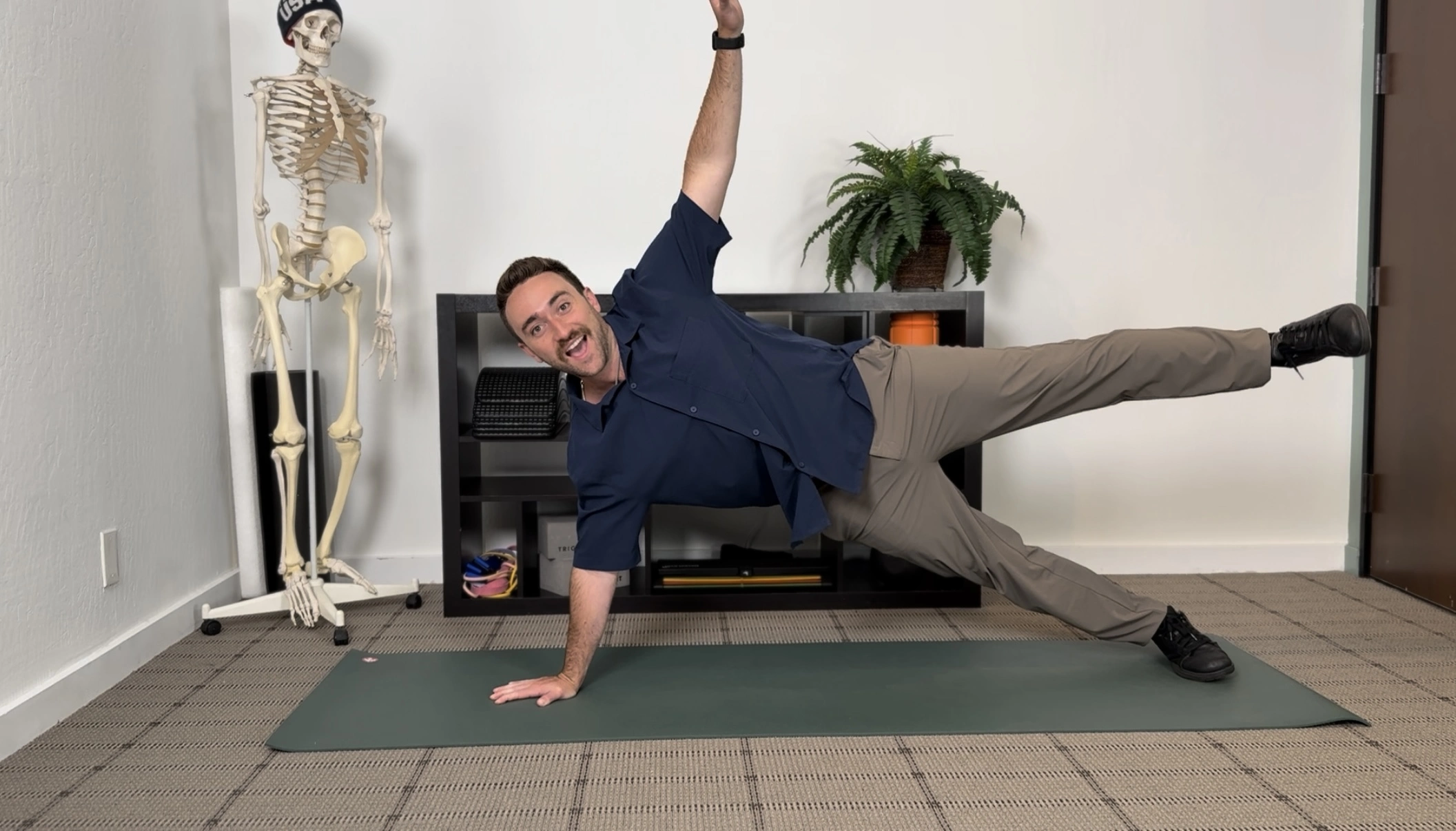
A great place to start is The McGill Big Three: modified curl-up, side plank, and bird dog. They train the body to maintain position under light stress and improve coordination between the front, side, and back of the core without overwhelming the system.
From there, dynamic exercises become essential. Pallof presses and suitcase carries are a couple of the best exercises to increase stability in your back. You resist being pulled into rotation while keeping the torso stable. Nothing dramatic is happening visually, but internally the deep stabilizers are working hard to prevent unwanted movement.
That same control shows up when carrying groceries in one hand, holding a child on one hip, or stepping out of a car while managing uneven load. This dynamic core loading also translates directly to rotational sports like golf, pickle ball, baseball, and tennis.
Posterior chain endurance work often gets ignored, but it is one of the most important pieces. Roman chair and hip hinge static holds build endurance in the spinal extensors and glutes. These muscles are responsible for maintaining upright posture and supporting the spine during long periods of standing, walking, and bending. When these muscles fatigue easily, the low back often becomes the first area to feel it.
Building a Resilient System
A well-trained core is not about doing more exercises. It is about covering all functions: resisting extension, rotation, side bending, and controlling rotation when it is needed. When all four are trained consistently, the spine becomes more stable under real-world conditions.
There is also an important caution. Poorly controlled high-repetition spinal flexion, especially when fatigued, can increase irritation in some people. The spine is adaptable, but it responds to how it is loaded. That is why progression and exercise selection matter more than intensity alone.
The real goal is not just stronger “abs”, but a coordinated pressure system around the spine that prevents low back pain and instability, while empowering you to live your life with confidence.